Wednesday, February 23, 2022

Triumph Idaho, North Fork Hyndman Creek, February 19, 2022

The Pioneer Mountains, east of Hailey, Idaho are big, beautiful mountains, with a population base of less than 40,000, compared to the Wasatch’s 2-million. Do the math, there’s a reason for the two-hour traffic jams in Little Cottonwood Canyon after each 2-inch dusting of powder. 

The Pioneers don’t get as much snow as the Wasatch, but, in my mind, the lack of crowds is a welcomed trade-off. Today there was about 20 inches at 8k feet, mostly supportable crusts with a corn-ish surface, which offered very fun skiing, but when those crusts broke I sank right to the ground. Under the crust is totally rotten snow with nothing to support a 155 pound skier. If I lost 10 pounds maybe I wouldn’t break through? (Philosophical questions abound.) I only broke through the crust a few times, once tripping me, resulting in a somersaulting-yard-sale, but no injuries and, more importantly, no damage to skis, no core-shots. Even with a thin snowpack, the skiing is good in the Pioneers.     

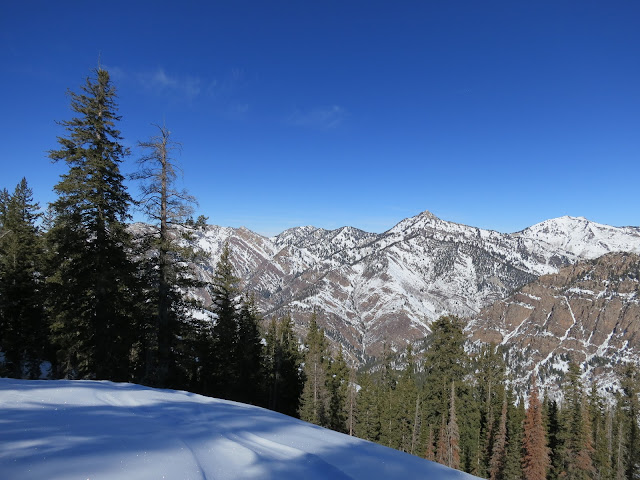
Idaho has big, impressive mountains that get very little attention, unlike lesser mountain ranges such as Utah’s Wasatch, which is over-hyped, over-developed, over-photographed and thus way over-used.  This is Cobb Peak (10,650 ft) viewed from near the junction of the Hyndman Creek trail and the Johnstone Creek Trailhead, which is about a half-mile from (east) the winter trailhead, which is about a mile down (west) of the summer trailhead because the road is not plowed.  Cobb has a vertical rise from its base at Hyndman Creek to the summit of nearly 4,000 feet with a continuous (no flats) slope of over 35 degrees. In comparison, the Wasatch is known for its stair-stepped topography, 1,000 foot steep drop then a 1,000 feet of flat-ish slopes, repeat. The Pioneer and Sawtooth Mountains are icons of continuous angles, with no crowds.   
 

Johnstone Creek trail, a half mile from the winter trail-head. 

 Trashy parents make trashy kids who become trashy parents . . . the cycle lives.


The conspiracy against e-bikes continues, based on weak personalities and misinformation. Face it, the greatest damage to a trail occurs when a rider (power assisted or free-pedaling) descend too fast, lock their brakes and skid, thereby trenching the trail. With the next big rain the trail erodes even more, by a factor of ten. It begins with poor bike handling, skidding down a trail with big knobby tires, and the trenching happens. Skid-mark riders are the problem, not E-bikes. 

Anyone who knows anything about cycling knows that Class-1 E-bikes do no more harm to a trail than a regular bike, except for maybe damaged egos of free-peddlers who can’t handle getting schooled. Simply put, the tires of a Class-1-E-bike DO NOT spin when the pedal-assist engages. It is NOT like a motorcycle or a Polaris side-by-side with huge engines and instant acceleration. The pedal assist of an E-bike is akin to a strong tail-wind but only when you mash the cranks. No spinning and no trail damage is possible. Ignorance may be bliss, but truth shall set you free.

Just know, one day your wife, or significant other, or perhaps even you, will stop riding because pedaling becomes a painful grind. But someday when your wife, significant other, or perhaps even you, gets an E-bike, your world will transform, you/they will again feel the joy and freedom of riding a bike in the mountains, without your lungs exploding. Your wife will start riding with you again and you will thank God for e-bikes, with  ZERO damage done to the trail. 

Free the trail and your mind will follow!   


Cobb Peak (r), 10,650 feet.

Another trailhead another mile up the trail. Apparently the road I’ve been skinning the last two miles is open to autos in the summer, but it's not plowed in the winter. That's OK, it keeps to maddening crowds at bay. 

Ski lines everywhere you look. North Hyndman Creek straight ahead. I ascended up the divide on the left (above my left ski tip), the divide between North Hyndman Creek and Button Creek.


North facing avalanche paths make great ski lines. The Pioneer Mountains east of Hailey/Ketchum are a cornucopia of ski lines.

Up on the Button Divide I skinned by this Moose bed, on the bare ground against a sheltering boulder, much warmer than sleeping on the snow. Moose aren’t stupid. 

Moose boulder with the North Hyndman vs. Hyndman Divide above.

Button Creek Peak? It’s listed as point 9,270’ on the map.

Looking back (west) the way I came, down North Hyndman creek drainage towards Triumph, Idaho.


Fun corny turns, until the crust breaks.

I love my BD Helio 88s (skis) with Atomic Backland Carbon Pros (boots). Light and high performing, more than their size and weights might suggest.


Friday, February 4, 2022

Mineral Fork, Big Cottonwood Canyon, February 4, 2022


“A mixed bag of shit," as so expressively worded by a skier we met a the trailhead when asked about the ski conditions. This is the view south towards upper Mineral Fork, the sun just above the ski run “Room of Doom.” The photo pretty much supports the review of the skier we met at the start, everything tracked out, the snow mostly hard/crusted/grabby but with two-inches of light powder covering it all, which is not nearly enough to make it good.

We skied one run down Highline, a run on the west side of the Mineral Fork, topping out on the divide of Mineral Fork and Mill B South (aka Lake Blanche Drainage). Today was a classic ‘one-and-done' day because we couldn’t justify skinning back up for a "mixed bag of shit.” We got maybe 10 fun, powdery turns and 300 challenging, grabby turns, so I was fine doing one run, then getting the hell out. Besides, I was hungry and Clif Bars suck after two or three, and a cheese-burger at Silver Fork Lodge was sounding pretty damn good.

The skinner up from BCC was hard-packed and wide, wide because on the descent is fast and one must make turns to control speed. Sadly, skiing down the skin track was the most enjoyable skiing of the day, chalky, easy-turning snow. 

View SW towards the Cardiac Bowl/Mineral Fork Divide.

View east from two-thirds up into Mineral Fork. Kessler Peak (10,403ft) is high-pint in the center (left high-pint). The fore-ridge on the left is the divide between Mineral Fork and the Greens Basin/Argenta/Gods Lawnmower areas, which are sandwiched between lower Mineral and Cardiff Forks.

View NE from Highline in Mineral Fork. Mount Raymond (10,241 ft) is the high-point dead center, Gobblers Knob (10,246 ft) is right-center. 


Sunday, January 23, 2022

Going Gentle, January 8, 2022


Wild men who caught and sang the sun in flight,
And learn, too late, they grieved it on its way,
Do not go gentle into that good night.
--Dylan Thomas


Good turning on the NW aspects, three-inches of powder on a solid base. The SW aspects are still a bit too thin, my pole often hitting ground during the skin up. 


KPF is brushy, easy to skin up but hellish to ski down, ski tips often grabbed/tripped. 

Looking down KPF towards the NW.


Rudy’s Flat under 83cm (32in).

Antelope Island from 7,900 feet.

29 degrees and 38 degrees (Fahrenheit and slope).


Mid Rectangle Bowl (7,800 feet) under 85cm (33in). Enough to ski but still thin. We need a series of big storms to set the winter right.

New boots on the skin track, Dalbello Quantum Free Asolo Factory 130. I bought these for their thicker liner to add some warmth, for the sake of my old, freezing toes now that I regularly get the Reynauds. Plus the Dal’s are stiff, they can easily handle my Helio 105’s, whereas my Atomic Backlands sometimes struggled on the 105’s. If the snow wasn’t soft and forgiving the DH could get ugly. My goal with new boots was to find some warmth while keeping it light. A tall order. I sized them myself because I don’t trust boot fitters anymore, they dictate rather than listen, which is annoying and has led to some shitty fitting boot. My last professionally-fit boot, a Dynafit TLT-6, was the worst fit I’ve ever had. The fitter constantly refuted my input, she had a fix for every issue - and there were many - so rather than admit the boots were wrong for my foot it became her personal odyssey to make them work. In short, I got shoe-horned into the wrong boot. After five-years of pain and many lost toe-nails, I bailed and bought some Scarpa F1’s, a big improvement but still not perfect. Since the TLT6 experience I’ve never gone with a pro fitter. This time, to get the right boot and the right fit, I did the rocket-test in the store to narrow the field, then bought three pairs of boots. I wore them around the house for three weeks in various combinations to find the right boot with the best fit. When I made the choice for the Dalbellos I returned the losers for full refunds $$. Here’s the try-out summary:
   
1 - Scarpa Maestrale - STRIKE 1: the warmest of the three and very comfortable, but heavy and the range of motion sucked, almost like an alpine boot even when in walk mode. Plus the sole length for a size 27.5 was 315mm, a full centimeter longer than my current rigs (Atomic Backlands and Scarpa F1s, both size 27.5) which meant I would have had to re-mount most of my skis.

2 - Fischer TransAlp Pro - STRIKE 2: Based on reviews these were the boots I planned to keep, but the fit was horrific. Even with the buckles maxed-tight I could still lift my heels substantially when walking up and down the stairs. The length was good because my toes were slightly curled against the front, so I tried footbeds but that pushed the problem (too loose at instep) forward, into the toe-box, albeit with even more toe curling against the front. Those Fischers were huge in the instep. They would’ve been a blister factory on the heels and a purple-toe-nail factory at the front, bar none. Neon green Fischers (Travers and TrasnAlps) are all the rage right now. Every other boot I see now in the BC is a Fischer, but I swear those things are molded for an Alien. I have an average size foot with a common shape, I’m still puzzled why they fit so strangely? I wonder how the masses of Fischer users make them work? Just know, for my foot the Fischers were a terrible fit, almost as bad as my TLT6s. Count me out. 

3 - Dalbello Quantum Free Asolo Factory 130 - HOME RUN! Great fit on all fronts. My toes were initially slightly curled, but with time the liners will compress and the toes will be fine. They have great range of motion when in walk mode, they feel light, airy and svelte, and when you transition to ski they are as stiff as my Nordica Supercharges (race boot). I’ve now skied in the Dalbellos six times, without heat molding. Natural packing results in a better fit, and without any guessing. My foot does the molding over time, albeit with some pain, but ultimately the boot is molded snuggly and with precision.

Heat molding and shell punching? Don’t even think on it. How many tales of whoah do we need? There are countless stories of BC skiers destroying expensive boots when they go full-on ‘McGeiver' with a heat gun, thinking they’ll get ‘Mod-Line-of-the-Year'  when attempting to 'punch’ the shell. When the heat gun comes out it becomes a guessing game, with zero science. The inside of a boot cannot be precisely mapped to the outside of the shell where the heat will be applied. Let the demolition begin. It’s like flossing the wrong tooth to find that kernel stuck in a molar. Before you know it your mouth is bleeding and you’re still probing for that kernel. If you are an educated engineer working in plastic thermo-dynamics then, yeah, maybe you are qualified to mess with a boot shell, but most of us are clueless. The best remedy is to buy the right boot and with the right fit from the start. Don’t shoe-horn anything. If that is required you are simply in the wrong boot.

Once you find the right boot, go forward with the correct mindset: no boot is perfect, there will always be an element of discomfort. For the best performance, both up and down, your feet will always hurt, even if just a bit. The only way to have zero foot pain is when barefoot on a north-shore beach on Kauai. Do you ever watch World Cup ski racing? If so you know the first thing they do upon crossing the finish line is they reach down and unbuckle their boots. Their fit is extremely tight and painful, yet they perform as needed. The more you ski the more you’ll demand performance. 

So far the Dalbellos have exceeded all expectations right out of the box. Unlike my F1s, and to a lesser degree the Backlands, they require very little fiddling at the transitions. This has much to do with the double cuffs which allow for tight, upper-buckling even when skinning, so no need to pull up pant cuffs to mess with the “DH fit” by cranking the upper buckles (the F1s are the worst, velcro buckles, huh??). All that's needed is to flip the lever into ski mold and you’re ready to ski. That is no lie, buckle tight when skinning and that double cuff moves like a well-oiled machine. Flip into to ski mode and that double cuff is rock solid. It's an ingenious design. Also, the Dalbellos were $100 cheaper than the Fischers, presumably because Fischer charges a premium due to their unprecedented popularity. The Dalbellos were a clear winner on every front.   


View SW over lower Rectangle Bowl.

View south over Rectangle Bowl towards Dead Tree Ridge.


Skin track into lower Rectangle Bowl.

Still thin cover on SW aspects, good enough for skinning but I didn’t trust it so I skied only on NW aspects.


Skin track up Rectangle Bowl. 

Ski tracks down The Rectangle (middle), skin track up Rectangle Bowl (middle right).

Session’s Mountain


Wednesday, January 19, 2022

Back Country Skiing with Fuller, Bountiful Ridge, December 28, 2021


Fuller in his element, ‘quit’ is not in his vocabulary. Why do I always have to be the responsible one?

It’s always a treat skiing with Fuller, especially when I’ve been out of commission for four weeks and still not feeling great. He’s 62, retired (he’s a $$$ genius) and drawing social security, and he reminded me of all that about 50 times today when I was struggling to keep up. When I finally showed some irritation he admitted it was payback for all the years of reversed roles, not that I am a $$$ genius, rather, I was usually the one pushing the pace. He mentioned biking this fall when I’d continually accelerate and drop him whenever we hit a hill. I had no idea, I’m slow but still like to push the pace. But that’s all bull-shit. Fuller never quits. He may start out at a moderate pace and I’m dropping him, but eight hours into the day and I’m crying when he’s only half done. I’ve learned from Fuller that short bursts mean nothing compared to long-term endurance. Best fitness lesson I’ve received is watching Fuller pace smartly, rewarded with  long days in the mountains.   

Exactly 24-inches at Rudy’s Flat (7,156 ft).

Still weedy headed toward Bountiful ridge, one-third the way to the ridge-crest above Rudy’s (7,500 ft). 

Skinning up the Rectangle Divide (8,200 ft), almost to the top. 

My skis have no rise, kept tripping on them. What ever happened to the real ski tips of 1978?

Rectangle Peak (8,293 ft). 


Cold day, ranged between 15 and 19 degrees Fahrenheit.

Good snow but still weedy cover in lower Mark’s Ghost.

The sun tried but could never quite break free.

Fuller breaking trail up the Crescent/Ghost divide.


I’m always intrigued with dead trees. Genetics from my Dad? Or do I just identify with old, dead things? Weird.


Three dead old trees under a frosty sun, one on fire (not quite yet dead), two going nowhere, but all three full of wisdom. Me? I’m the simple, follower, taking photos.  

Did I say Fuller never quits?

Beautiful dead trees . . . .

 . . . and then there’s this. Why? Fucking dip-shits everywhere. Trash begets more trash, and trash (the fucking dip-shits) create more trash. In a year this meadow will look like the Bountiful City Landfill. Ski Bountiful Dump! The skiing may stink, but at least the approach is short.